

Native botanicals are transforming the fragrance industry by offering plant-based ingredients that are sourced locally, environmentally friendly, and biodegradable. These plants, like Australian sandalwood, boronia, and wattleseed, not only create complex scents but also support local ecosystems and communities. Ethical brands, such as Goldfield & Banks, are leading the way by prioritizing sustainable harvesting, fair trade practices, and transparent sourcing. With the fragrance market projected to grow significantly, native botanicals are shaping a more responsible and mindful future for perfumery.
Key takeaways:
- Eco-friendly benefits: Native plants reduce emissions through local sourcing and break down naturally without polluting.
- Economic impact: Fair trade practices provide steady income for growers while protecting endangered species.
- Unique scents: Native botanicals offer complex profiles that synthetic alternatives can’t replicate.
- Ethical practices: Transparent supply chains and sustainable methods ensure long-term balance between production and conservation.
This shift aligns with consumer demand for eco-conscious products, making native botanicals a cornerstone of modern perfumery.
Scents of nature - nature in a bottle | Inspired by nature | ABC Australia
sbb-itb-a2a0d05
How Native Botanicals Support Sustainable Perfumery
Native botanicals play a key role in ethical perfumery by working in harmony with nature. These plants are naturally suited to their local ecosystems, meaning they grow without the heavy irrigation, chemical fertilizers, or pesticides often required by non-native species. This built-in resilience helps minimize environmental impact throughout the production process.
Their advantages go beyond cultivation. By sourcing locally, perfume makers cut down on shipping-related emissions and energy consumption. The production process becomes cleaner, relying on biodegradable ingredients and reducing wasteful packaging. These practices align perfectly with the values of eco-conscious consumers, especially in the growing market for unisex fragrances.
Environmental Benefits of Using Native Plants
Sustainable harvesting methods ensure that plant populations can naturally regenerate. Controlled quotas and cultivation programs provide a steady supply of ingredients without depleting resources.
This approach also promotes biodiversity. When perfume brands focus on native species, they create financial incentives to protect natural habitats. A great example is agarwood production - sustainable harvesting has made preserving these trees more profitable than clearing them for agriculture. This shift has turned forest communities into protectors of their ecosystems rather than exploiters. Similarly, Australian sandalwood plantations have helped reduce the strain on wild Indian sandalwood, which was once on the brink of extinction due to overharvesting.
Supporting Local Communities and Growers
Ethical sourcing directly benefits local economies. Growers of native botanicals earn premium prices for sustainably harvested ingredients, ensuring a steady income that doesn't rely on exhausting natural resources.
Transparency in sourcing fosters trust. Leading perfume brands openly share where their ingredients come from, how they're harvested, and the partnerships they maintain with growers. This openness allows consumers to verify ethical claims and ensures that local communities are fairly compensated. With the niche fragrance market expected to hit $5.73 billion by 2034, sourcing native botanicals sustainably offers not only an ethical path but also a significant economic opportunity for communities managing these resources. This commitment to transparency and community well-being strengthens the ethical foundation of modern unisex perfumery.
Australian Native Botanicals Used in Ethical Fragrances
Australia’s rich and diverse plant life provides perfumers with an extraordinary array of ingredients, many of which are seldom seen in traditional fragrance formulations. These native botanicals not only offer unique scent profiles but also create a meaningful link between modern luxury perfumes and the natural heritage of the continent. Among these, three stand out for their role in ethical, unisex fragrances: Sandalwood, Boronia, and Wattleseed. Let’s explore what makes each of these ingredients so special.
Sandalwood
Australian Sandalwood, primarily sourced from Western Australia, is a cornerstone of luxury fragrances. Known for its warm, woody aroma, this ingredient thrives in the region's sunlit landscapes. The oil extracted from these trees is of exceptional quality, making it a favorite for high-end perfumes. Its neutral yet rich character allows it to serve as a versatile base for unisex fragrances, complementing a variety of other scent elements and enhancing the overall complexity.
Boronia
Brown Boronia, native to Tasmania, is one of the rarest and most sought-after floral ingredients in perfumery. Before Australian perfumers brought it to the forefront, this botanical was largely overlooked by the global perfume industry. Its intricate floral scent profile adds a layer of depth and elegance to niche fragrances. Even among seasoned perfumers from prestigious French fragrance houses, Boronia remains a rare and highly prized ingredient.
Wattleseed
Golden Wattle, celebrated for its Wattleseed, introduces an earthy and refined touch to fragrances. This ingredient captures the essence of Australia’s distinctive landscapes with its unique aromatic profile. Beyond its olfactory appeal, Wattleseed carries cultural importance, symbolizing Australia’s botanical heritage. The brand "Goldfield & Banks" pays tribute to Joseph Banks, the first European botanist to catalog Australian flora, reflecting a commitment to honoring native plants. Ethical sourcing practices ensure full traceability, supporting local growers and preserving ecosystems.
These botanicals not only elevate the artistry of modern perfumery but also highlight the importance of sustainable and ethical practices in the fragrance industry.
Goldfield & Banks: Ethical Perfumery with Native Botanicals
The Vision Behind Goldfield & Banks
In 2016, Dimitri Weber, a French-Belgian fragrance expert, launched Goldfield & Banks with a bold idea: to showcase Australia's untapped botanical treasures in fine fragrance. Weber envisioned a luxury fragrance house that combined the purity of Australian botanicals with the refined techniques of French perfumery.
"The vision was clear: to honor this land through a gender‐free collection that pairs native Australian botanicals with French perfumery savoir-faire." – Dimitri Weber, Founder and Creative Director
The brand's name is a nod to Joseph Banks, the famed botanist, and the poetic image of Australian Sandalwood flourishing on "fields of gold" [1, 14]. This vision comes to life in a collection that captures the beauty and diversity of Australia's landscapes.
Fragrances Featuring Native Ingredients
Goldfield & Banks' fragrances not only celebrate Australia’s unique botanicals but also tell stories of its varied landscapes. Each scent is a sensory journey:
- Pacific Rock Moss evokes the breezy, sunlit feel of a summer walk along New South Wales' coastline.
- Southern Bloom highlights the rare Brown Boronia, sourced from Tasmania’s Bruny Island.
- White Sandalwood offers rich, woody notes inspired by the heritage of Western Australia, evoking the imagery of trees thriving on "fields of gold."
- Blue Cypress captures the fresh, invigorating essence of Kakadu.
- Velvet Splendour radiates the golden beauty of Wattle blossoms in full bloom.
Commitment to Ethical Sourcing
Goldfield & Banks ensures its fragrances are as responsible as they are luxurious. The brand collaborates with experienced botanical growers and essential oil producers to guarantee sustainability and full traceability for every ingredient [3, 5].
"We engage with only the most experienced growers, who are passionate about premium crops with full traceability from the field to the final product." – Goldfield & Banks
Their commitment goes beyond sourcing. For instance, Queensland Agarwood in Silky Woods is sustainably harvested, and the brand has pioneered the use of organic Beetroot Alcohol as a substitute for traditional denatured alcohol. Every perfume is 100% cruelty-free and crafted to International Fragrance Association standards, with most being vegan-friendly (except Silky Woods and Velvet Splendour, which include organic beeswax).
"To us, luxury is defined not as extravagance, but the use of the finest essences available without compromising the earth." – Goldfield & Banks
Native Botanicals vs. Non-Native Ingredients
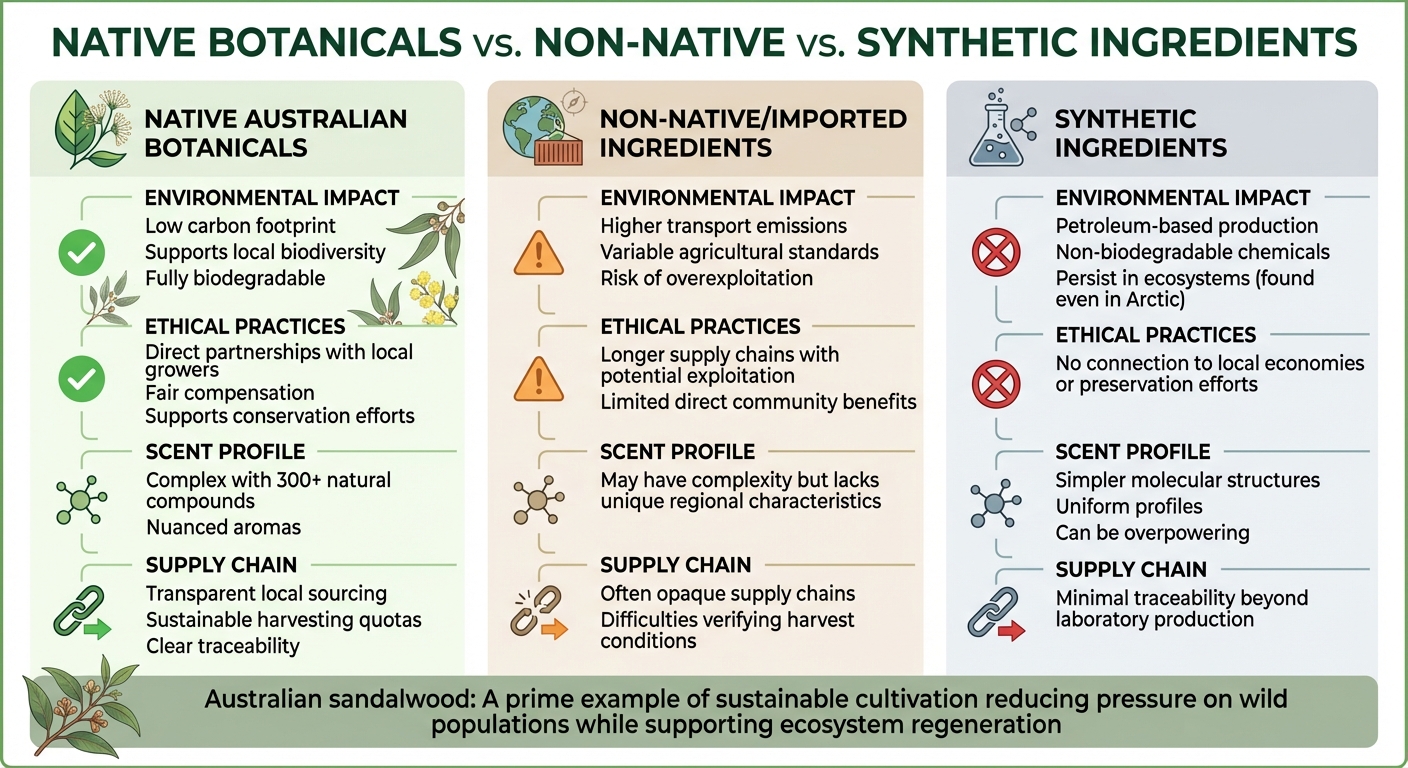
Native Botanicals vs Synthetic Ingredients in Ethical Perfumery Comparison
Choosing between native Australian botanicals and imported or synthetic ingredients brings to light key differences in environmental impact, ethical practices, and scent quality. Native botanicals come from renewable plant sources, unlike synthetics, which are often derived from petroleum-based materials. These synthetic compounds can harm the environment, lingering in ecosystems for years. For example, synthetic musk compounds have even been found in remote areas like the Arctic. This stark contrast underscores the unique benefits that native botanicals bring to the table, particularly in terms of their natural scent profiles.
What sets native botanicals apart is their intricate and layered scent profiles, something that science struggles to replicate. A single botanical perfume may contain more than 300 distinct aromatic compounds, creating a depth and complexity that synthetic alternatives simply can't achieve. Take Australian sandalwood, for instance: it offers creamy, woody notes with subtle nuances. Similarly, boronia delivers a rare floral richness, while wattleseed adds a warm, nutty undertone.
Another major advantage of native botanicals lies in their transparent and ethical supply chains. By working directly with local growers and employing sustainable harvesting methods, these practices ensure traceability and ethical sourcing. In contrast, imported ingredients often rely on global supply chains that are harder to track, increasing the risk of overexploitation. Synthetic ingredients, on the other hand, offer minimal traceability and lack any meaningful connection to conservation or origin stories.
Comparison Table
| Criteria | Native Australian Botanicals | Non-Native/Imported Ingredients | Synthetic Ingredients |
|---|---|---|---|
| Environmental Impact | Low carbon footprint; supports local biodiversity; fully biodegradable | Higher transport emissions; variable agricultural standards; risk of overexploitation | Petroleum-based production; non-biodegradable chemicals that persist in ecosystems |
| Ethical Practices | Direct partnerships with local growers; fair compensation; supports conservation efforts | Longer supply chains with potential exploitation; limited direct community benefits | Lacks connection to local economies or preservation efforts |
| Scent Profile | Complex, with over 300 natural compounds delivering nuanced aromas | May have complexity but often lacks the unique regional characteristics of native botanicals | Simpler molecular structures; uniform profiles that can be overpowering |
| Supply Chain Traceability | Transparent local sourcing with sustainable harvesting quotas ensuring clear traceability | Often opaque supply chains with difficulties verifying harvest conditions | Minimal traceability beyond laboratory production |
Australian sandalwood serves as a prime example of how sustainable practices can balance conservation and commerce. By cultivating this resource responsibly, pressure on wild populations is reduced, while ecosystems are given a chance to regenerate. This approach demonstrates how ethical perfumery can align with environmental stewardship.
The Future of Ethical Perfumery with Native Botanicals
The natural fragrances market is on a remarkable growth trajectory, climbing from $4.67 billion in 2024 to an expected $9.84 billion by 2032, with an annual growth rate of 9.8%. This rise reflects a clear shift in consumer priorities - 75% of consumers now actively seek brands that emphasize sustainability and environmentally conscious ingredients. Leading this movement are brands like Goldfield & Banks, which have embraced these values since their inception.
At the heart of this transformation is the concept of "ecological luxury", offering premium natural essences while respecting the planet's limits. Goldfield & Banks has championed this philosophy since 2016, forming transparent sourcing relationships with skilled Australian growers.
The industry is now moving beyond sustainability toward regenerative practices that actively restore ecosystems. Judith Gross, Vice President of Communication and Branding at IFF, highlights this evolution:
"Fragrance is shifting toward regenerative narratives, upcycling, circularity, rewilding, and olfactive signatures inspired by soil, moss, bark, tomatoes, ivy, mushrooms, and storm‐washed minerals".
This regenerative approach ensures production processes not only protect but can even enhance ecosystems - a principle Goldfield & Banks has adhered to through its close collaborations with local growers.
Consumer demand for transparency is also reshaping the market. Eighty-five percent of consumers now scrutinize labels for ingredient sourcing, driving the industry toward greater accountability. Practices like direct partnerships with local growers, traceability from field to bottle, and the use of premium native oils - long championed by Goldfield & Banks - are becoming essential.
Emerging trends such as hyper-local sourcing, gender-neutral luxury, and discovery-driven consumption are redefining how people connect with fragrance. As urban living expands, many consumers are drawn to scents that evoke the natural world - think damp earth, cascading waterfalls, or lush foliage - as a sensory escape from city life. Ethical perfumery, rooted in native botanicals, is no longer a niche movement; it's becoming the foundation for the future of the fragrance industry.
FAQs
How can I tell if a perfume’s botanicals are truly traceable?
To check if a perfume's botanicals are genuinely traceable, focus on brands that clearly disclose their sourcing methods and ingredient origins. Some companies go the extra mile by sharing specifics about native botanicals and how they maintain ethical and transparent supply chains. This level of openness not only builds trust but also ensures responsible practices in their production.
Are native-botanical perfumes better for sensitive skin?
Native-botanical perfumes tend to be easier on sensitive skin since they typically rely on natural ingredients with fewer synthetic chemicals or artificial additives that might trigger irritation. Goldfield & Banks creates its fragrances with care, using pure Australian native botanicals, blending a commitment to eco-conscious practices with skin-friendly formulations. However, because everyone's skin reacts differently, it's always a good idea to do a patch test before using any perfume extensively - even those made with natural ingredients.
Do natural native ingredients make a fragrance last longer?
Native botanicals are known for their ability to make fragrances last longer. Ingredients such as sandalwood, boronia, and wattleseed stand out for their deep, long-lasting scents. Frequently found in essential oils and resins, these natural components not only extend a perfume's wear time but also bring a distinctive aromatic quality that sets them apart.